ARTICLES · 206
The End of Work as You Know It
An essay by a 21-year-old entrepreneur
Written in Spanish by Álvaro. English translation with AI. Read the original in Spanish.
Quotes from other people are translated back from the Spanish, so the wording may differ from the original.
You probably already feel it.
That strange feeling when you watch the news and see another mass layoff. When you hear someone talking about AI in a conversation and you're not quite sure whether to be scared or excited. When you finish the day with no clear idea whether what you did matters, or whether in two years a machine is going to do it for a tenth of the cost.
Something is really changing. And most people feel it but don't know how to put it into words.
This article is that attempt.
I'm not going to tell you to learn to code, or take an AI course, or "adapt to change," that empty phrase repeated for twenty years by the same people who never adapted to anything.
I'm going to tell you what's really happening, why the system we were promised is reaching its limit, and the one thing no machine can take from you, however hard it tries.
But to get there, we first have to look at what we'd rather not see.
Everyone is saying it. Nobody is listening.
In February 2026, James Van Geelen published an essay on Substack written from the future. Specifically, from June 2028.
It was called The 2028 Global Intelligence Crisis.
Van Geelen is no internet alarmist. He wanted to be a doctor, couldn't get in, and ended up as a paramedic in Los Angeles. From there, with no contacts on Wall Street and no experience in finance, with degrees in biology and psychology, he started an investment newsletter called Citrini Research. In 2022 he went short on Silicon Valley Bank. Months later, the bank collapsed. Citrini became the most-read finance newsletter on Substack, built on a reputation for spotting investment trends before they become obvious. He wrote the essay with Shah, an investor who sold his financial AI company for more than 200 million dollars in 2022.
The essay described a world where AI had replaced the knowledge worker so fast that the economic system had entered what they called "economic thrombosis": corporate profits were growing, productivity was soaring, but money stopped circulating. Machines don't draw a paycheck, don't pay mortgages and don't go to the supermarket on Friday.
Within 48 hours that article moved 300 billion dollars in the markets. Shares of Visa, Mastercard, DoorDash and Uber fell in a single session. Michael Burry, the man who predicted the 2008 crisis and whom the world knows from the movie The Big Short, referenced it publicly, saying "And you think I'm a pessimist." Wikipedia gave it an entry before the week was out. When Bloomberg called him, Van Geelen said: "If I had known the markets were going to react, I wouldn't have published it for free."
Four days later, Jack Dorsey announced that Block, the company behind Square, Cash App and Afterpay, was laying off 40% of its workforce. From ten thousand people to six thousand in one day. The stock rose 22% the next day.
In his letter, Dorsey didn't hide behind euphemisms. He said that "intelligence tools" let smaller teams do the same work. And he added something that should have kept us up at night: "I think most companies will reach the same conclusion in less than a year."
What the letter didn't mention is what came next. Three weeks later, Block began quietly rehiring laid-off employees. A design engineer named Andrew Harvard found out his layoff had been an "administrative error," four days after losing his job. A tech lead named Richard Hesse was left alone on his team, spent two days convincing management that he needed his people back, and got some of them rehired. On X, someone wrote: "Companies don't lay off 4,000 people by clerical error. That's a process with approvals, HR and legal. Calling it an error after the fact is a framing choice, not a description of what happened."
Not even the people leading this know exactly what they're doing, but they're doing it anyway.
Dario Amodei spent years building the most advanced AI models in the world inside OpenAI before founding Anthropic, the company behind Claude. In February 2026 he sat down for three hours with Dwarkesh Patel and said, bluntly, that he expects to have "a country of geniuses in a datacenter" in 2026 or 2027. That progress in coding is moving faster than he himself predicted. That Anthropic went from zero to ten billion dollars in revenue in three years. And that the most surprising thing isn't the speed of the advance, but that almost nobody realizes how close we are to the end of the exponential.
In case you have the time, here's the full interview
But the detail that matters most to me is another one. When Dwarkesh asked him why he doesn't buy more compute if he believes general AI is so close, Amodei explained that if he's off by a year in his demand projections, Anthropic goes bankrupt. Even the man behind the company that has taken the throne from OpenAI in recent months is buying less than he should out of fear of overestimating the speed.
Sam Altman, CEO of OpenAI, warned that same month that white-collar executive jobs are at risk. Jamie Dimon has spent thirty years at the head of JPMorgan surviving every financial crisis while others went under; he asked society to prepare for massive job displacement. Khosla, who cofounded Sun Microsystems, estimates 80% displacement. Schmidt, who turned Google into what it is after years as its CEO, says we're still underestimating it. Kiyosaki, the well-known author of Rich Dad Poor Dad, has spent decades warning about crises the system took a long time to recognize, and now predicts a collapse accelerated by AI. Musk talks about a hard takeoff right now.
If you still think this is a bar conversation on Twitter, you're wrong. These are the people signing the contracts, building the models and moving the capital.
And then there's Geoffrey Hinton.
Hinton has spent forty years building the systems that make all of this possible. Along with Yann LeCun and Yoshua Bengio, he developed the deep neural networks that are the basis of every AI model that exists today. For that work he received the Nobel Prize in Physics in 2024, and he's recognized worldwide as the godfather of Artificial Intelligence. In 2023 he resigned from Google so he could speak without filters, because he felt that inside the company he couldn't say what he really thought.
He said on 60 Minutes that the problem isn't the technology itself. The problem is the structure of the economic and social model, which isn't ready to withstand what's coming.
The Nobel laureate of AI, recognized worldwide as the godfather of this new technology. Saying that the social structure isn't ready. If you still think this is an exaggeration you're being very ignorant, and ignorance is fear's best friend.
The numbers nobody is looking at
While all this plays out in the headlines, here are some of the quieter data points that explain why nobody seems especially alarmed.
The American economy lost 92,000 jobs in February 2026 alone. In the last year it added only 156,000 in total, which used to be the monthly average in any year between 2011 and 2019.
Job postings for people with zero to two years of experience have fallen 29% since January 2024. In tech, 35%. In finance, 24%. Juniors aren't finding work, and if you're between 20 and 30 you know what I'm talking about. Not because the market is bad in general, for now. It's terrible for us specifically, AI isn't replacing seniors yet, it's eliminating the first rung of the ladder.
The response from young people is curious.
Because we don't seem too scared.
Only 17% of Generation Z consider having a high-status job part of a good life. Only 28% want to get rich. 67% would rather earn less at a job that respects their mental health than earn more at a high-stress one.
It's not that they don't want to work, it's that they've spent their whole lives watching what work did to their parents and constantly comparing themselves to other people's lives on social media: they've drawn their own conclusions about what's worth it and what isn't.
What's really happening
Van Geelen and Shah describe something they call the "intelligence displacement spiral": AI improves, companies need fewer workers, the displaced spend less, weakened companies invest more in AI to protect margins, AI improves more. This technology is nothing like what we're used to, there's no "natural" brake, it grows exponentially. Each company's individual response is completely rational, the collective result is a loop that feeds itself.
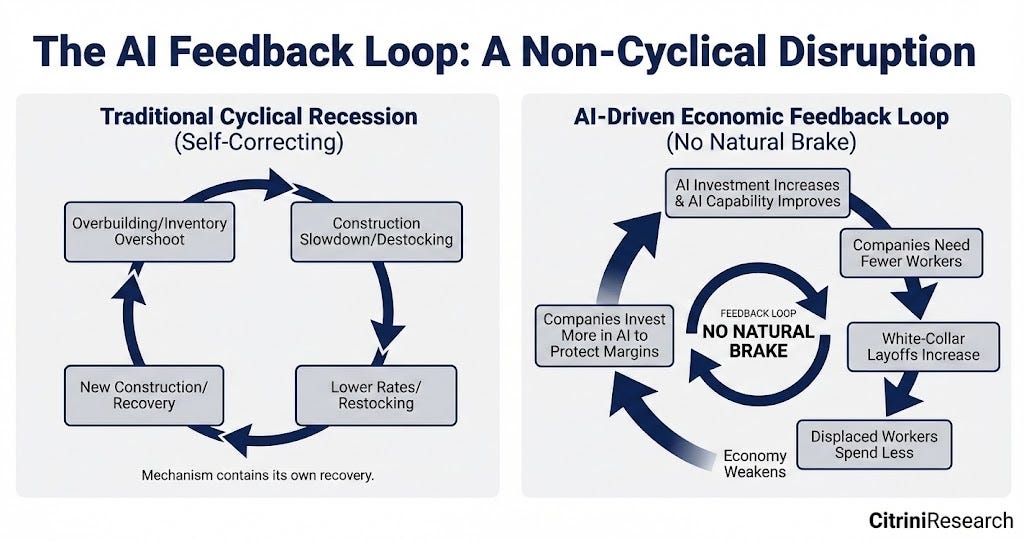
Credits: Citrini
The specific mechanism is this: the American mortgage market holds 13 trillion dollars in debt. The upper middle class, the profiles banks considered safe (AAA), the ones with stable jobs and good salaries, are exactly the ones most exposed to AI displacement. If they stop paying, the housing market goes into crisis. The government prints money, inflation eats up savings. Sounds a bit like the scenario that set off the 2008 crisis.
The Citrini article itself warns that this isn't a prediction. It's a scenario, a way of forcing us to think about what would happen if everything the AI optimists say turns out to be true.
And this is where Beliūnas comes in.
Beliūnas writes one of the most-followed fintech newsletters in the world, with more than 370,000 subscribers among investors and executives in the financial sector. He published his response to Citrini with a title that says it all: The 2035 Global Intelligence Crisis.
His argument isn't that the scenario is wrong, it's that the timeline is compressed to the point of making it implausible. E-commerce took fifteen years to reach 5% of American retail. The smartphone, the fastest technology adoption in modern history, took five years to reach a majority of the market. There's no historical precedent for a structural transformation at the speed Citrini describes. The difference between a crisis in 2028 and a transition lasting until 2035 isn't a technical detail. It's the difference between a collapse of the economy and a silent reorganization that's just as dangerous or more so.
He may be right.
But Morgan Housel, the author of The Psychology of Money, has a concept that fits perfectly here: the paranoid optimist. Not the person who believes everything will be fine, but the one who accepts that the short term will hurt and trusts the long term without ever ceasing to prepare for the pain.
Nassim Taleb put it from another angle in Antifragile: "Wind extinguishes a candle and energizes fire. The same goes for randomness, uncertainty, chaos: you want to use them, not hide from them. You want to be the fire and wish for the wind." Uncertainty isn't the problem, without uncertainty life wouldn't be any fun, the fragility in the face of it is. And the paranoid optimist is, by definition, antifragile: he positions himself to win from volatility instead of praying it doesn't come.
Both attitudes at once.
Whether the scenario arrives in 2028 or in 2035 matters less than the fact that the direction is clear.
Better to be prepared.
Is it good or bad?
Neither. It's inevitable.
There are extraordinarily positive consequences. A medical AI model running on cheap hardware already beats the average human doctor in almost half of clinical evaluations. Elon Musk says that in ten years everyone on the planet will have access to better medical care than the richest person in the world has today.
And there are brutally negative consequences. Millions of people out of work in a system designed so that your identity, your social structure and your money are all tied to employment.
The solutions being debated are familiar. Universal basic income or equity in the technology. Musk has been defending it since 2017, when he told the World Government Summit there's no alternative once robots do the work. At the Abundant Summit he said that robots and AI will produce so many goods and services that they'll literally run out of things to do for humans. And that at some point, money will stop being relevant, he literally said recently that in 10-20 years it won't make sense to have savings, and urged people to spend without fear. You're right to be skeptical when these scenarios come up, but Elon was talking about this in 2017, almost 10 years have gone by, and today it's one of the most discussed topics when it comes to AI. I repeat, paranoid optimism.
These are valid ideas, but they stay on the surface.
The real problem isn't AI.
It's how society is organized, Hinton said so. And if we take a little perspective, it's worth considering that he's right.
The system nobody questioned
Industrial capitalism as we know it is barely 200 years old. Humanity has been on the planet for more than 100,000 years.
Think about that for a moment.
We've lived under absolute monarchies, under feudalism, under institutionalized slavery, under imperial bureaucracy. Every time the system reorganized itself there was real suffering in the transition. And every time, afterward, most people lived better.
The industrial revolution started from a simple principle: if one person produces a teaspoon, a hundred people produce a hundred teaspoons. That principle was applied to human capital. The entire economy was built on people using technology to become more and more productive. More productivity, more growth, more employment, more consumption.
But we're reaching the end of that exponential.
The point where technology no longer makes us more productive, but replaces us.
The clearest signal is in the financial markets. Seven tech companies represent a third of the value of the S&P 500, compared to 12% a decade ago. Their returns between 2016 and 2025 were 875%, versus 235% for the index. An economy that's starting to consume itself. The profits go to the owners of capital, in this case of compute.
And meanwhile, most of the people going to work on Monday don't really know why they're paid what they're paid.
McCann is the founder of TrueNorth. He published an article on Substack about the uselessness of corporate employment that racked up 12,000 likes, an unheard-of figure on that platform. He named it "The Great Pretending": the idea that most corporate employees know their job is performance art, but nobody wants to admit it.
He describes people who manage projects that exist to justify the existence of project managers, who create strategies for strategies, who optimize things that were working fine. Human middleware between systems that could talk directly to each other: AI is far more efficient at passing information along than the 5 meetings you have a day.
When it went viral, the comments split in two: young people felt validated. But those with decades of career behind them felt attacked, maybe most of them have built their own farce. McCann summed it up in his next article: "Young people felt seen. Older people felt described."
AI is exposing this problem.
Capitalism, if you think about it coldly, is a system that works very well for anyone motivated to create something that improves other people's lives, or to solve something they're missing. But for the vast majority of society, who go to work on Monday without really knowing why, it's a trap. Society is structured so that you become part of the production system. You go to school, you study for a degree, you get a diploma or a master's to post on LinkedIn to show others that you know x, but more important than that: you're obedient. And only those who think outside of that can really enjoy its benefits, because the opportunities are out there and anyone who makes the effort can reach out and take them.
Motivation, as Maslow described in 1943, works by deficit: we're moved by what we lack, not by what we already have. The industrial capitalist system is perfect for someone who's hungry for something. The problem is that more and more people are no longer hungry for anything material. And without a real deficit, without real motivation, AI is going to amplify this until it's impossible to ignore.
But before this paralyzes you, I need you to do something
I need you to take a step back.
Way back.
In 1920, average life expectancy in the US was 54. Today it's 77. In 1900, global child mortality was 33%: one in three children died before the age of five. Today it's under 4%. Extreme poverty affected 85% of humanity in 1800. Today, less than 9%. Seventy years ago, most homes in Spain had no hot water. When the industrial revolution began, five-year-olds worked in factories. Seriously now, when was the last time you took a hot shower thinking about absolutely nothing but the luxury you were enjoying, instead of what's going to happen or what already happened?
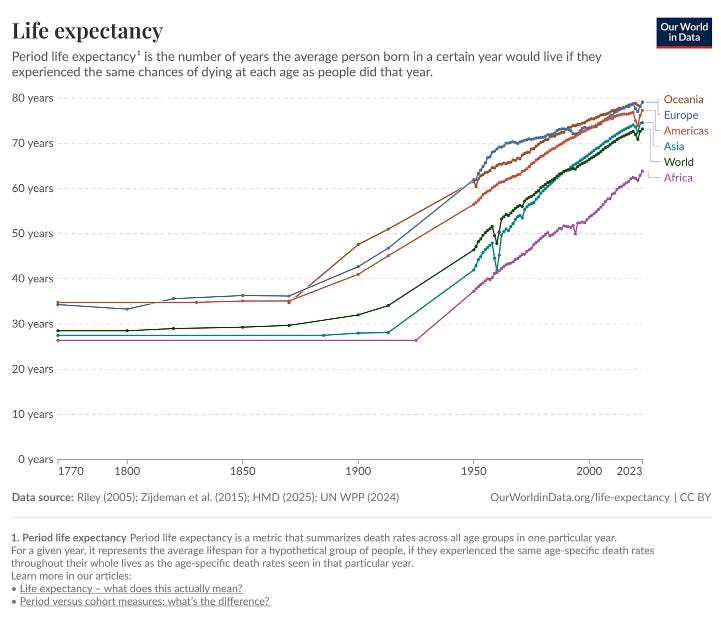
Every great technological disruption in history has the same pattern: real destruction of what existed, real suffering in the transition, and a net long-term improvement for the majority. Again, paranoid optimism.
Without exception.
Hans Rosling was a doctor, a statistician and a professor at Sweden's Karolinska Institute. He spent decades gathering data on human development around the world and discovered something that deeply disturbed him: people, even the most educated and well-informed, had a view of the world systematically more negative than the data justified. He devoted the last years of his life to proving it with numbers. Factfulness, his book published shortly before he died, is the most rigorous answer there is to the human catastrophizing instinct: we have a neurological bias that makes us see the world as worse than it is, not because we're stupid, but because our brains evolved to detect threats, not to measure accumulated progress.
The world has improved radically and systematically, and I at least trust that it will keep doing so.
Keynes wrote about it in 1930, in an essay titled Economic Possibilities for our Grandchildren. Keynes was the most influential economist of his time, the man who redesigned the international financial system at Bretton Woods. In that essay he predicted that by 2030 humanity would have solved the economic problem thanks to technology. And that the real problem it would have to face would be existential: what to do with free time when we no longer need to work to survive.
Ninety-five years later, we're getting exactly there.
But here comes the paradox nobody wants to look at head-on.
More than ever. Unhappier than ever.
The US fell from 15th to 23rd place in the World Happiness Report between 2023 and 2024. The decline is driven by people under 30. The richest nation in history has the unhappiest young generation ever documented. The WHO says anxiety is the most common mental disorder in the world. Gallup has spent fifteen years recording what it calls a "rising tide of unhappiness and isolation" in the American adult population. 91% of young people in Generation Z report mental health challenges at least occasionally.
More material prosperity but less subjective well-being.
Why?
Barker lived it firsthand, he spent fifteen years turning his life into a climbing machine. He started as a junior salesperson at a Vancouver startup and ended up cofounding a venture capital fund. He learned fintech, then software, then media, then venture. He optimized everything that could be optimized. And when he got to the top he discovered there was nothing up there. Severe anxiety, addiction, burnout and depression. An identity that existed only in relation to the next achievement and that crumbled as soon as there wasn't one in sight. Side note, think now about the digital entrepreneur of the moment with his Lamborghini and Rolex, well, I'd stop envying him so much. Barker published an article about it that reached more than 200,000 readers, but what struck me most was the first long comment: a crisis case manager in Maui who works with 138 survivors of the Lahaina fire, thirty years in mental health, telling him that his advice assumed a privilege most people don't have.
The crisis that's coming isn't just for those who have a lot and fear losing it, it's for everyone, but the symptoms are different.
Sun writes for The Atlantic and the New York Times, cofounded Reboot, and is cowriting a book with Kevin Roose of the NYT about the race between the AI labs. Her newsletter is an ethnographic inventory of how Silicon Valley's tech ecosystem builds identity through jargon: "high-agency," "NPC," "above the API," "below the API." Her point: the more threatened professional identity is by AI, the more obsessively people get sorted into winners and losers.
I couldn't agree more.
The more we have, the more we identify with what we have. With the job, with the degree, with the salary and with the image we project. The ego, that mental construction we wear as a mask to seem competent and likable, is living its golden years in a society obsessed with having and with constant comparison.
And that identification profoundly disconnects us from who we really are.
AI is going to take that to a breaking point.
The biggest threat to the ego in history
AI is going to systematically dismantle every identity we've built around performance.
If you're a very good lawyer, AI will be a better lawyer. If you're a very good analyst, AI will analyze faster and with fewer errors. If your value lies in what you produce, you're in replacement territory.
And when that happens, not if, when, you're going to have to face the question you've spent years avoiding.
Who are you when you take all of that away?
If right now you're reading this and thinking about how it's going to affect your career, your industry, your specific position, you already know what I'm talking about. That's the ego's automatic response to a threat to what it believes you are.
Carl Jung, the Swiss psychiatrist whose work remains a central reference in twentieth-century psychology, put it this way: "When an inner situation is not made conscious, it happens outside, as fate." The crisis we don't look at inside shows up as an external threat that happens to us without our understanding it.
This confrontation has a name, and it's called an existential crisis. In our society, with little emotional education and almost no spiritual education, it usually arrives disguised as depression, anxiety, addiction, medication. Because we don't know what to do when the identity we thought we had stops working, when everything you defined yourself by no longer convinces you and you feel from the very deepest part of you that there's no going back.
But there's something on the other side of that crisis.
Viktor Frankl was a psychiatrist, a neurologist and a survivor of four Nazi concentration camps, Auschwitz among them. What he observed while he was a prisoner changed his life and the lives of millions of people afterward. The prisoners who had a purpose, like finishing a manuscript (he himself), seeing someone again or keeping a promise, survived longer than those who didn't. From that he built an entire therapeutic school, logotherapy, based on a simple idea: suffering is bearable when it has meaning. What destroys people isn't pain. It's emptiness.
And purpose doesn't appear when you look for it. You have to prepare for purpose, and it will show up when you least expect it. Put another way: it's not what you do but how you do it.
It doesn't have to be grandiose, in the society we live in it seems like whoever draws the most attention is worth the most, and if you think about it, whoever draws the most attention is very probably the one who feels the emptiest. It can be being a good father, looking after a friend at their worst moment, creating something that helps others. If we pay attention, purpose is always something that has to do with other people. And that, that specifically, no AI can replicate.
The World Economic Forum evaluated nearly 2,900 skills to measure how replaceable they are by generative AI. The result was unexpected: none with a "very high" capacity for replacement. Skills rooted in genuine human interaction, like real empathy, judgment, presence and care, showed zero potential for replacement.
Zero.
Not because AI can't imitate them, AI can imitate them very well. But because imitating isn't the same as being. And humans, deep down, can tell the difference. We have a sixth sense for figuring out other people's intentions, machines for now don't hide behind what they say. Or do you thank your toaster in the morning? Then stop thanking ChatGPT.
There are three ways to respond to this. Only one works in the long term.
The first is the most urgent right now: learn to use AI and use it. As a tool it's incredible, stop thinking it can't do x yet, I assure you it can, get your act together and learn to use it, there's no excuse for being ignorant. Anyone who can use AI agents fluently is already in the top 0.1% of their company. That's now, in six months it'll be the minimum requirement. Advise companies on implementing it, create with it, you can do anything you can imagine. There have never been so many possibilities, and it has never been so easy to reach so many people with so few resources. This window is open, use it.
The second works in the medium term: build something real with it. A company, a product, an audience. Something that isn't just your time in exchange for money. AI has made the cost of building almost zero, and careful, this also makes the value of what gets built almost 0, SaaS is fucked. You're probably asking yourself, if I can build anything but it's not going to be worth anything, why are you telling me to start creating? Here's the answer: what's still scarce is the judgment to know what's worth building, and for that you need a little creativity and critical thinking, things you're not going to get by looking at the guy next to you.
The third is the hardest and the only one that really matters in the long term: discover what makes you unique in a way no machine can replicate.
Forget about technical skills, about degrees, or about whatever it is you do with your life.
The things your friends call you for when something goes wrong, what you were good at when you were eight without anyone teaching you, the way you see the world that nobody else has in exactly the same way.
Joseph Campbell, the American mythologist who spent his entire life studying the universal patterns of human storytelling across all the world's cultures, says it better than I can: "Enter the forest at the darkest point, where there is no path. If there is a path, it's someone else's path. You're not on your own adventure." In an era of mass automation, your own path isn't a choice, it's the only way to remain irreplaceable.
In the face of disruption, the answer isn't to search desperately for a new purpose, we've already said you don't search for it! It's to live inside the question, and those with the tolerance to do it will find something that those who run away will never find.
And the ones who will really succeed in what's coming will be those who manage to combine all three: knowing themselves, applying it with the new tools, and creating something that improves other people's lives.
What's coming
In the short term, this is going to cause suffering. A lot of lost jobs, a model of society that doesn't hold up and a speed of change that no institutional, educational, political or financial system is prepared to absorb.
But if you look at the whole pattern of history, the net result will be positive. Paranoid optimism…
We're in free fall toward the future. We don't know where we're going, and all you have to do to turn your hell into paradise is to make your fall a voluntary act.
A society that produces more and needs less human effort to do it has, for the first time, the real possibility that people will use their time for whatever they want. To create, to be with whoever they want, to discover who they are and what really motivates them. To live, instead of just functioning. As we get older it seems like life goes by faster, maybe it's that we're so busy we forget to live in the process.
The era in which machines can do everything could be the most human in history.
Because it will force us to recognize that what really matters to us isn't what we do.
It's what we are.
And we'll realize, at last, that nothing we accumulate really belongs to us.
Why I'm telling you all this
I've spent more than a year building something.
It was born exactly at the intersection of everything you've just read. The mental health crisis that's already here. The technological advance that's already here. The scenario being laid out. And a question that hasn't left me in peace for as long as I can remember.
Who are you when you take everything else away?
I'm 21 years old. I know how that sounds coming from someone my age. But the credit for what you'll find here isn't mine. Everything that appears in this newsletter will be backed by recognized studies, psychologists, philosophers, neuroscientists and psychiatrists. The team behind the project is what connects the dots.
The project will be available to everyone in November 2026. Before that, limited-access versions will come out so we can keep polishing the tool, I need your help.
Today I'm making it public with this article.
If you subscribe, you'll have access to what I discover along the way. Artificial intelligence and self-knowledge, what happens outside and what happens inside. Because both things are the same conversation, and almost nobody is having it.
The world is changing faster than anyone can process.
But the most important question isn't how to adapt to that.
It's who you are in the middle of all this.
Waitlist for the project behind moji.
References
Amodei, D. (2026, February). Interview with Dwarkesh Patel. Dwarkesh Podcast. https://www.dwarkesh.com/p/dario-amodei-2
American Psychological Association. (2025). 2025 work and well-being survey.
Barker, S. (2026, February). How to prepare for the next decade. The Wake Up Call.
Basu, A. (2026, March). A brutal jobs report. Sage Economics.
Beliūnas, L. (2026, February). The 2035 global intelligence crisis. Linas's Newsletter.
Campbell, J. (1988). The power of myth. Doubleday.
Campbell, J. (1990). The hero's journey. Harper & Row.
CBS News. (2023, October). Geoffrey Hinton on AI dangers — 60 Minutes transcript.
CNN Business. (2026, February). Block lays off nearly half its staff because of AI.
Fortune. (2026, February). Jamie Dimon: Society must prepare for AI job displacement.
Fortune. (2026, February). Sam Altman on AI and white collar jobs.
Frankl, V. E. (1946). Man's Search for Meaning. Beacon Press.
Gallup and Walton Family Foundation. (2024). Voices of Gen Z: Year 2 annual report.
Housel, M. (2020). The Psychology of Money. Harriman House.
Illingworth, S. (2026, March). Stop calling them soft skills. Slow AI.
Indeed Hiring Lab. (2025, September). September labor market squeeze on new entrants.
Jung, C. G. (1951). Aion. Princeton University Press.
Keynes, J. M. (1930). Economic possibilities for our grandchildren.
Kiyosaki, R. (2025). AI-driven economic collapse prediction. Yahoo Finance.
LIMRA. (2024). 2024 BEAT study: Gen Z mental health in the workplace.
Maslow, A. H. (1943). A theory of human motivation. Psychological Review, 50(4), 370-396.
McCann, A. (2025, August). The death of the corporate job. Still Wandering.
Musk, E. (2017). On why the world needs a universal basic income. World Government Summit.
Musk, E. (2025). Interview at Abundant Summit with Peter Diamandis.
Rosling, H. (2018). Factfulness. Flatiron Books.
Schmidt, E. (2025). The AI revolution is underhyped.
Sun, J. (2025). The Silicon Valley dictionary. jasmi.news.
Taleb, N. N. (2012). Antifragile. Random House.
Van Geelen, J. and Shah, A. (2026, February). The 2028 global intelligence crisis. Citrini Research.
World Happiness Report. (2024). Sustainable Development Solutions Network.
Yahoo Finance. (2025). Vinod Khosla says AI could displace 80% of jobs.
Written in Spanish by Álvaro Molina and first published on Substack (original). English translation with AI. Quotations from English-language sources are translated back from the Spanish unless marked otherwise, so their wording may differ from the original.